Repetition is a design element that can be appreciated at Sunsplash Gardens.
For instance, purple coneflowers (Echinacea) repeat throughout the cottage garden.
Now that's a lotta coneflowers, eh? And this is just the cottage garden. I also have them in the border gardens. And color? Well, I only have pink ("purple") and white. I've had an orange and a yellow coneflower in the past but both succumbed to the dreaded aster yellows disease. I have lost many of the purple coneflowers to aster yellows as well, but I have so many, and they self-seed prolifically.
In the photos above, you may have noticed another repeater in my garden: monarda or beebalm. I have it growing in four spots in the cottage garden. I love how its bright color sets off the other flowers.
I also repeat larkspur. It is so pretty and self-sows very well. See it in the photo immediately above in the lower area (purple, pink, and white).
Phlox repeat in my garden as well...if you have any, they are probably repeating for you as well. They just keep moving along! Above, 'Eva Cullem.'
Daylilies have their own dedicated garden room that I call Daylily Junction. There are also many scattered throughout the gardens. I have close to 100 daylilies! Love them!
Do you use repetition in your garden? And if so, what plants?
AND, do you have any of these little sweethearts in your yard?
This baby robin left the nest today. There are two still in the nest and I'm sure they will be moving along soon.
Wednesday, July 9, 2014
Monday, July 7, 2014
Storms bring pretty sunsets
The midwest has been having a number of thunderstorms, including tornadoes, damaging hail, and flooding. We personally have been spared, for which I am thankful.
Last evening there were a reported 11 tornadoes in the state, the closest to us being about 30 miles away. While we didn't get a storm here, we got the clouds! Take a look:
Weeks ago, a robin built a nest on top of our light fixture. She and her mate raised four babies there. Now, there are more (at least three).
Sweet little birdies!
Last evening there were a reported 11 tornadoes in the state, the closest to us being about 30 miles away. While we didn't get a storm here, we got the clouds! Take a look:
Weeks ago, a robin built a nest on top of our light fixture. She and her mate raised four babies there. Now, there are more (at least three).
Sweet little birdies!
Thursday, June 26, 2014
Summer is the best time!
It's summer. It's hot. It's humid. It's rainy; so rainy, in fact, that I keep getting "flash flood warnings" from the National Weather Service on my phone. Actually, we have gotten a nice amount of rain here but in northern Iowa they have gotten way too much, and our rivers are swelling - and flooding too.
In addition to working in my own garden, I've been helping a fellow Master Gardener who is having some pain issues to whip her garden into shape (i.e., weeding and deadheading).
Mosquitoes abound after all of the rain. Ticks are around too. And those 17 year cicadas - have you heard about them?
The periodic cicadas emerged after 17 years underground, where they fed on tree roots. They will mate, lay eggs, and in 4 - 6 weeks, they'll be gone. Their offspring will emerge in another 17 years.
Some people think they are extremely "yukky," but I think their story is kind of cool. We have had a few in our yard and many more in some areas of town.
Walking about the garden, you'll note the blueberries are beginning to ripen. They don't all ripen at once, which is a good thing. The robins and catbirds have been chowing down and I've picked my fair share as well.
My one and only delphinium. They are so pretty; I think I will be adding more next spring.
The beebalm is striking. I use it as a repeater in multiple areas of the garden. It really stands out.
The annual rudbeckia are colorful as well. Not sure if this is two plants growing together, or if the flower starts out plain yellow and then develops the red center.
Red and purple look nice together. Here, it's larkspur and achillea (yarrow) 'Paprika.'
There isn't much more delicate and beautiful than a ruffled poppy. This is poppy somniferum 'Lilac Candy Floss.' I planted these from seed and they self-sow.
While walking in this area of the garden, I noticed a sweet fragrance. I thought it might be the poppy, but no, it was the common milkweed. I allow these to grow for the monarchs.
Speaking of milkweed, this is swamp milkweed and I think it's absolutely gorgeous.
Sedum along the stone pathway
Hydrangea 'Incrediball' is a great performer. This plant is only two or three years old.
The coneflowers are beginning to bloom now. They are absolutely one of my favorite flowers.
Clematis (cultivar unknown) is doing well in the garden. I need more of these beauties - I probably have 15 or so but room for more!
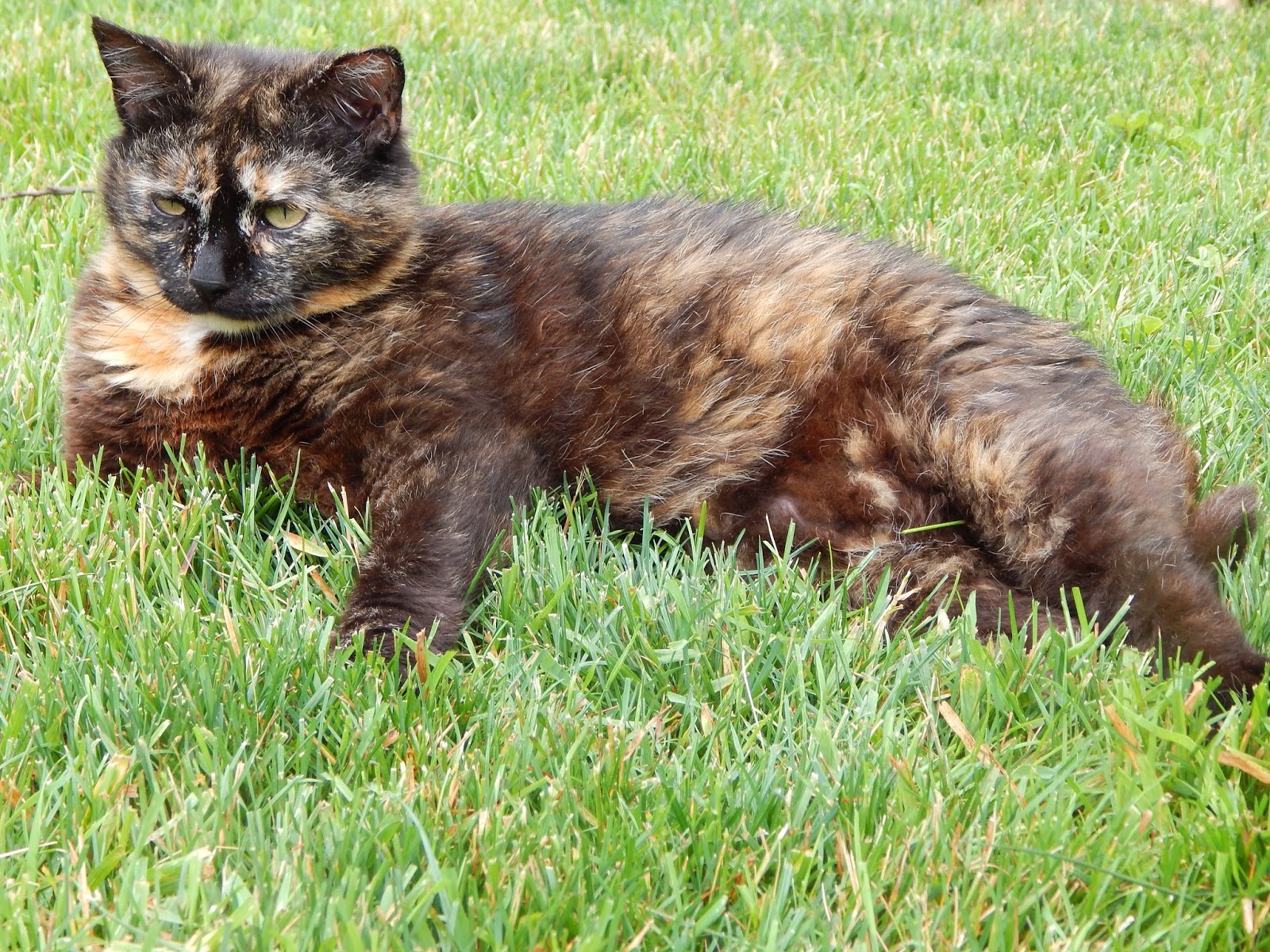
Tortie, Garden Supervisor
Summer is the best of times. So many fun things to do, better food, no snow to shovel, and, of course, FLOWERS!!! I find myself continually looking out the window onto the garden when I'm inside...and I like what I see. Uniquely mine, designed by me, but growing and thriving through the grace of God.
In addition to working in my own garden, I've been helping a fellow Master Gardener who is having some pain issues to whip her garden into shape (i.e., weeding and deadheading).
Mosquitoes abound after all of the rain. Ticks are around too. And those 17 year cicadas - have you heard about them?
The periodic cicadas emerged after 17 years underground, where they fed on tree roots. They will mate, lay eggs, and in 4 - 6 weeks, they'll be gone. Their offspring will emerge in another 17 years.
Some people think they are extremely "yukky," but I think their story is kind of cool. We have had a few in our yard and many more in some areas of town.
Walking about the garden, you'll note the blueberries are beginning to ripen. They don't all ripen at once, which is a good thing. The robins and catbirds have been chowing down and I've picked my fair share as well.
My one and only delphinium. They are so pretty; I think I will be adding more next spring.
The beebalm is striking. I use it as a repeater in multiple areas of the garden. It really stands out.
The annual rudbeckia are colorful as well. Not sure if this is two plants growing together, or if the flower starts out plain yellow and then develops the red center.
Red and purple look nice together. Here, it's larkspur and achillea (yarrow) 'Paprika.'
There isn't much more delicate and beautiful than a ruffled poppy. This is poppy somniferum 'Lilac Candy Floss.' I planted these from seed and they self-sow.
While walking in this area of the garden, I noticed a sweet fragrance. I thought it might be the poppy, but no, it was the common milkweed. I allow these to grow for the monarchs.
Speaking of milkweed, this is swamp milkweed and I think it's absolutely gorgeous.
Sedum along the stone pathway
Hydrangea 'Incrediball' is a great performer. This plant is only two or three years old.
The coneflowers are beginning to bloom now. They are absolutely one of my favorite flowers.
Clematis (cultivar unknown) is doing well in the garden. I need more of these beauties - I probably have 15 or so but room for more!
Tortie, Garden Supervisor
Summer is the best of times. So many fun things to do, better food, no snow to shovel, and, of course, FLOWERS!!! I find myself continually looking out the window onto the garden when I'm inside...and I like what I see. Uniquely mine, designed by me, but growing and thriving through the grace of God.
Sunday, June 22, 2014
Tales of the Monarch and Black Swallowtail
They're here! Black Swallowtail caterpillars have arrived (already) in my gardens.
Below, some pretty butterfly/caterpillar photos from a past summer:
I've lost track of the butterfly-to-be when it forms a chrysalis. I've heard that the caterpillar moves from the milkweed to a suitable (hidden?) location. It is in the chrysalis for about 10 days before emerging as a beautiful butterly. Its life as a butterfly lasts from 2-6 weeks.
Speaking of interesting, did you know that there are 4 generations of Monarchs born each season? It all begins in March/April when the first generation is born and goes through the 4 stages of the life cycle: egg, caterpillar (larva), chyrsalis (pupa), adult butterfly. In May/June the cycle repeats for the 2nd generation. July/August is when the 3rd generation is born.
In September/October the 4th generation is born - egg, caterpillar, chyrsalis, adult butterfly...but THIS generation does not die. It migrates and lives for 6-8 months in Mexico or Southern California. The Monarchs begin awakening and mating in February/March of the next spring and then lay their eggs. After living for much longer than the other 3 generations, with their purpose met, they finally die. (Information from MonarchButterflyUSA.com).
Below, some pretty butterfly/caterpillar photos from a past summer:
In 2011, I wrote about the life cycles of the Black Swallowtail and Monarch and I thought you might like to read about them again.
This is one of the earlier instars of the Black Swallowtail caterpillar; it will turn to the green/yellow/black (first photo on this post) as it gets older and sheds this skin.
An interesting fact about the life cycle of the black swallowtail: caterpillars that pupate earlier in the summer leave the chrysalis as adult butterflies in about ten days.
Caterpillars that pupate later in the season may experience diapause, a delay in development which is a physiological state of dormancy used as a means to survive unfavorable environmental conditions, such as temperature extremes, i.e. winter, drought, or reduced food availability. What this means is that these caterpillars rest over the winter in their chrysalis and hatch as adults in the spring time. This is one reason that some environmentalists say you should delay cutting back/cleaning up your garden waste from fall to spring. (I'll still be cutting mine back, but I'll be very mindful and observant of possible chrysalis in amongst my plants.)
Now, a little information about Monarchs.
Monarch caterpillars on the butterfly weed. The life cycle of the Monarch is incredible. The cycle begins with a tiny egg, which is generally laid on some type of milkweed. When it hatches in about 4 days, it is as a tiny caterpillar that eats and grows for about two weeks. When I have been observed these wonderful caterpillars (and black swallowtail caterpillars as well) over two weeks, their growth rate was simply incredible.
Note the larger caterpillar and smaller one are sharing the same leaf! I thought this made an interesting photo.
Speaking of interesting, did you know that there are 4 generations of Monarchs born each season? It all begins in March/April when the first generation is born and goes through the 4 stages of the life cycle: egg, caterpillar (larva), chyrsalis (pupa), adult butterfly. In May/June the cycle repeats for the 2nd generation. July/August is when the 3rd generation is born.
In September/October the 4th generation is born - egg, caterpillar, chyrsalis, adult butterfly...but THIS generation does not die. It migrates and lives for 6-8 months in Mexico or Southern California. The Monarchs begin awakening and mating in February/March of the next spring and then lay their eggs. After living for much longer than the other 3 generations, with their purpose met, they finally die. (Information from MonarchButterflyUSA.com).
Subscribe to:
Posts (Atom)